
October 27, 2026 I 4 minutes read
For all the talk about the AI boom, consumption remains the main engine of U.S. economic growth. Yet sentiment has soured as households chafe at higher prices for everything from gasoline to groceries. Americans nonetheless keep spending on food, travel, Halloween costumes, and almost everything else they need or want. Higher prices explains part of the increase, but consumers are also buying more in real terms, even as income growth fails to keep pace. If paychecks alone are not funding this retail therapy, what is?
Part of the answer lies in the familiar wealth effect: when stock prices rise, households feel richer and spend more, even without selling a single share. What has changed is the scale. Since 1990, stock holdings have grown twice as fast as household income and now makes up roughly one-third of household net worth. Thirty years ago, household stock holdings were worth half a year’s disposable income; today, nearly three times as much. Put differently, a 10% stock-market rally is now akin to a 30% boost to after-tax income, at least on paper. Not every dollar is spent, but fatter portfolios give households the confidence to choose the better restaurant, upgrade from a three-star hotel to four, or save less of each paycheck. Across millions of households, those choices add up, pushing the savings rate toward levels last seen before the Global Financial Crisis. Yet saving less can only go so far. Some are taking the next step: cashing in their investments.
JPMorganChase research shows that more people across all age groups are moving money both into and out of their investment accounts than in 2019 (see the chart below). More Americans are investing, but more are also withdrawing money from their portfolios into checking accounts¹ to spend. The share of consumers making such withdrawals is now double its 2019 level and triple its 2015 level, with the sharpest rise among young adults. Investment gains are becoming a source of spending power, not merely confidence. The classic K-shaped economy narrative holds that a stock-market rally mainly benefits wealthier, older households. On ownership alone, that is hard to dispute: the top 1% hold half of all household stocks. But dismissing the other 99% would be a mistake. Stocks have claimed a steadily larger share of their net worth too, and while their individual holdings are smaller, they spend far more of each extra dollar than the wealthiest do. A billionaire whose portfolio rises by $1 million is unlikely to change how she lives; a teacher whose brokerage account rises by $5,000 may well book the family vacation. Multiplied across tens of millions of households, that spending carries real economic weight.
So, are consumers defying inflation? Not quite. They feel the pinch, but rising stock wealth is helping them look past it. For now, Americans seem more likely to vent their frustration at the ballot box than at the cash register. As long as markets hold up, the cycle may continue: rising stocks lift household wealth, wealth supports spending, and spending drives growth. America’s mighty consumers may be in a lousy mood, but their stock-market gains could make them mightier still.
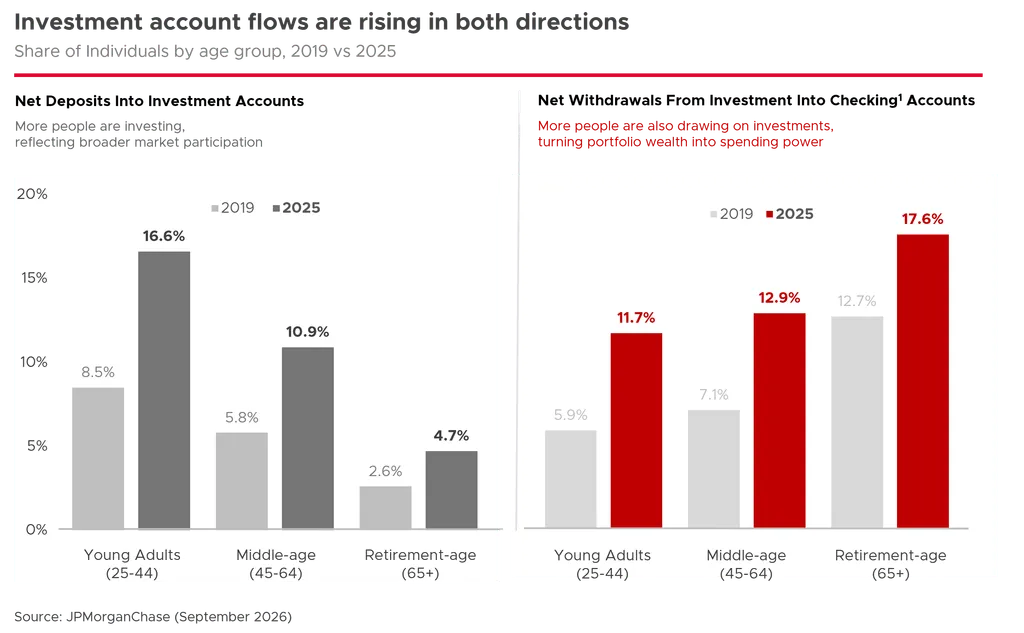
1: Used to settle card payments, bill payments, and cash withdrawals. Checking balances are small relative to spending (about 2–3 weeks of outflows for the median individual) and remain close to their pre-pandemic trend. This suggests that money drawn from investment accounts is funding ongoing spending rather than building cash buffers.
DISCLOSURES
The information provided is for educational purposes only. The views expressed here are those of the author and may not represent the views of Leo Wealth. Neither Leo Wealth nor the author makes any warranty or representation as to this information’s accuracy, completeness, or reliability. Please be advised that this content may contain errors, is subject to revision at all times, and should not be relied upon for any purpose. Under no circumstances shall Leo Wealth be liable to you or anyone else for damage stemming from the use or misuse of this information. Neither Leo Wealth nor the author offers legal or tax advice. Tax services provided are separate from the Securities or Advisory services offered through Leo Wealth Americas. Please consult the appropriate professional regarding your individual circumstance. Past performance is no guarantee of future results.
This material represents an assessment of the market and economic environment at a specific point in time. It is not intended to be a forecast of future events or a guarantee of future results.
